
Oral surgery
Oral surgery in Lugano and Bellinzona
Extractions, wisdom teeth, cysts and infections: procedures carried out with modern techniques and, for those who wish, under conscious sedation.
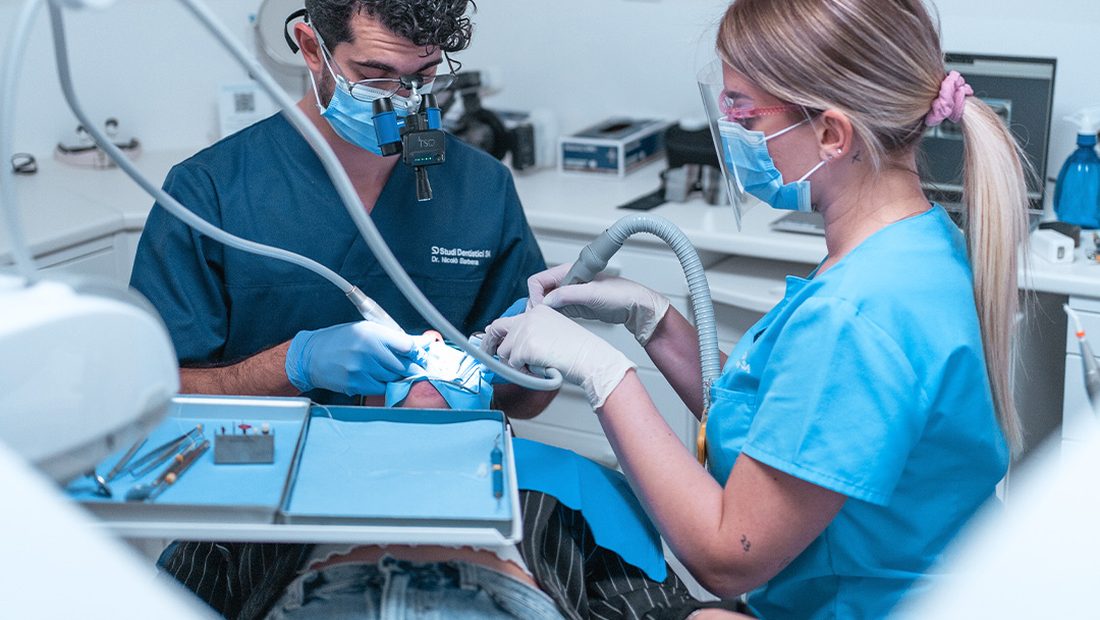
What we treat
We carry out simple and complex extractions (including wisdom teeth and impacted teeth), removal of cysts and small soft-tissue lesions, treatment of oral infections, apicectomies (surgical removal of the tip of a root when root canal treatment alone is not enough) and bone grafting in preparation for implants. Every procedure is planned on X-rays and explained clearly before we proceed.
3D diagnosis with cone beam CT
Where a conventional X-ray is not enough — wisdom teeth close to the nerve, cysts, impacted teeth, planning for bone grafts or implants — the practice is equipped with a cone beam CT scanner that produces 3D images of bone, roots and anatomical structures. It allows us to measure the position of nerves and sinuses precisely and plan the procedure in detail, reducing risk, surgery time and surprises, at a radiation dose far lower than a hospital CT scan.
Wisdom teeth
Third molars often lack the room to come through properly: they stay impacted in the bone or partly covered by gum, causing recurrent inflammation, decay in the neighbouring tooth or pain. In these cases, extraction is the safest course. The procedure is performed under local anaesthetic, usually in 20 to 40 minutes per tooth, and recovery is easier than the reputation of wisdom teeth suggests — especially when the extraction is not put off until it becomes an emergency.
Conscious sedation
Oral surgery is led by Dr Alessandro Maria Volpi, who completed postgraduate training in oral surgery at the University of Turin and is a sedation dentist. For anxious patients, longer procedures or several extractions to be completed in one visit, he offers conscious sedation: you remain awake and able to respond, but deeply relaxed and with no unpleasant memories. It is also the answer for anyone with a real fear of the dentist.
After your procedure
You receive written post-operative instructions — ice, soft foods, caring for the area, medication to take — and a direct contact for any questions. Swelling and discomfort for the first two to three days are normal and manageable with ordinary painkillers; removal of stitches and follow-up visits are part of the treatment. For urgent problems — acute pain, abscesses, injuries — see our dental emergencies page.
After an extraction: what about the gap?
An extracted tooth should normally be replaced, because neighbouring teeth tend to drift and the bone to shrink. When an extraction is planned, we can preserve the bone volume at the time of surgery and, in suitable cases, place the implant in the same session. The options — implant, bridge or denture — are discussed with you, with a clear estimate.
Frequently asked questions
Does having a wisdom tooth out hurt?
Not during the procedure, thanks to the local anaesthetic. Swelling and some discomfort, manageable with painkillers, are normal over the following days. By following the post-operative instructions, most patients are back to normal within two to three days.
Should I have my wisdom teeth out even if they don't bother me?
Not necessarily. If they have come through properly, are easy to clean and are not damaging the neighbouring teeth, they can stay. If they are impacted or partly covered by gum, it is often better to remove them before they cause trouble, while the procedure is simpler.
Can I drive after a procedure under conscious sedation?
No. After conscious sedation you must be accompanied home and must not drive for the rest of the day. We give you full instructions before the procedure.
Where to find us
This treatment is available at both of our practices in Ticino.
Bellinzona practice
As easy as a smile.
Check availability and book your appointment online in Lugano or Bellinzona.